Planet Earth(Our Home)
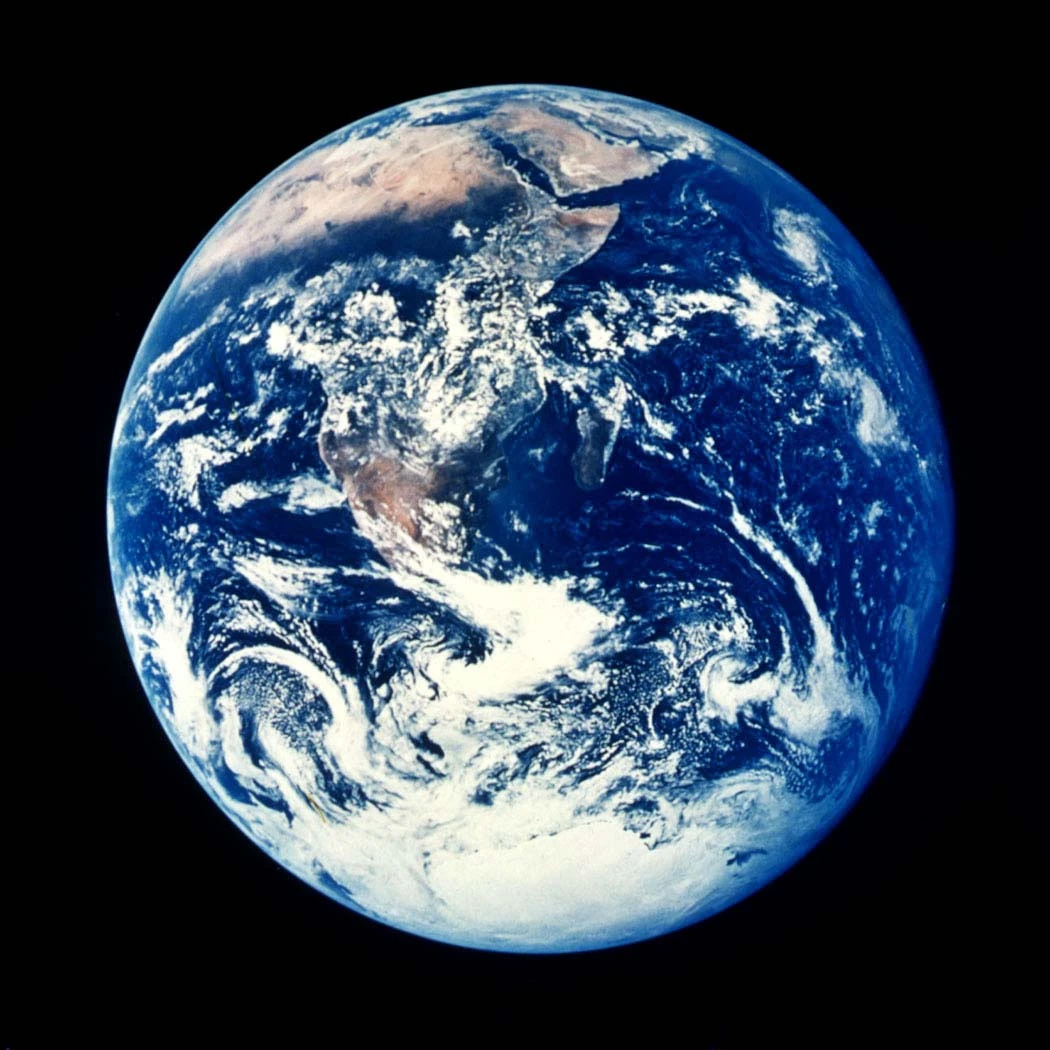
Earth is the third planet from the Sun and is the largest of the terrestrial planets. Earth is the only planet whose English name does not derive from Greek/Roman mythology.
1.Size and Shape
Earth is not perfectly spherical in shape. it has Equatorial Diameter(12,756 km) and Polar Diameter(12,714 km)
"At the equator, one would weigh less than if standing at one of the poles"
2.Densest Planet
The Earth is the densest planet in the Solar System.The average density of the Earth is approximately 5.52 grams per cubic centimeter.
3. Speed Of earth
The Rotation speed of earth is close to 1000 miles per hour (1600 km/hr) whereas It's also moving around the sun at 67,000 miles (107,826 km) per hour
4. Age
Researchers calculate the age of the Earth by dating both the oldest rocks on the planet and meteorites that have been discovered on Earth.They found that Earth is about 4.54 billion years old.
5. Naming
Earth is the only planet not named after a god.The other seven planets in our solar system are all named after Roman gods or goddesses
6. Hottest and Coldest Spot
3. Speed Of earth
The Rotation speed of earth is close to 1000 miles per hour (1600 km/hr) whereas It's also moving around the sun at 67,000 miles (107,826 km) per hour
4. Age
Researchers calculate the age of the Earth by dating both the oldest rocks on the planet and meteorites that have been discovered on Earth.They found that Earth is about 4.54 billion years old.
5. Naming
Earth is the only planet not named after a god.The other seven planets in our solar system are all named after Roman gods or goddesses
6. Hottest and Coldest Spot
El Azizia, Libya is hottest spot where temperature records 136 degrees Fahrenheit (57.8 degrees Celsius) on Sept. 13, 1922.
The lowest temperature ever recorded on Earth came from Russia's Vostok Station, where records minus 128.6 degrees F (minus 89.2 degrees C) on July 21,1983,
7. Tallest Mountain
The tallest mountain is Mauna Kea if one measure from ocean floor. Mount Everest is highest mountain above sea level around 29,029 feet (8,848 meters) high. However, when measured from its ocean base, Mauna Kea is tallest mountain, with a length of about 56,000 feet (17,170 m).
8. Leap Year
Earth makes one revolution, or one complete orbit of the Sun, in about 365.25 days. so the extra .25 day is adjusted as in leap year. after every four year 1 day is added to 365 days, that year become leap year.
9. Powerful Magnetic Field
Earth has a powerful magnetic field.This is caused by the nickel-iron core of the planet, coupled with its rapid rotation. This field protects the Earth from the effects of solar wind
10. Aurora
7. Tallest Mountain
The tallest mountain is Mauna Kea if one measure from ocean floor. Mount Everest is highest mountain above sea level around 29,029 feet (8,848 meters) high. However, when measured from its ocean base, Mauna Kea is tallest mountain, with a length of about 56,000 feet (17,170 m).
8. Leap Year
Earth makes one revolution, or one complete orbit of the Sun, in about 365.25 days. so the extra .25 day is adjusted as in leap year. after every four year 1 day is added to 365 days, that year become leap year.
9. Powerful Magnetic Field
Earth has a powerful magnetic field.This is caused by the nickel-iron core of the planet, coupled with its rapid rotation. This field protects the Earth from the effects of solar wind
10. Aurora
An aurora, sometimes referred to as a polar lights or northern lights, is a natural light display in the sky, predominantly seen in the high latitude (Arctic and Antarctic) regions.


Comments
Post a Comment